Monday, March 20, 2017

Mugu field trip to the far north -west


It took me two flights and nearly two days to reach our working area in Mugu and three days to get a return flight back out. This because the airstrip at Talcha, in Mugu district, is little more than a runway built into the side of a mountain. As the little twin engine plane comes in to land there, it banks and turns so I was sure one wing would hit one of the steep, high  hills ( in the UK we would call them mountains. As the plane lands it has no need to lose height, it just glides onto the runway which is at the same altitude of 8,920 feet or 2,719 metres. Everyone clapped on landing!
The journey from Kathmandu takes 4 full days by vehicle so I was glad to be able to fly to Napalgunj, in the hot and completely flat terai region bordering India, and then
 on to Mugu the next day when the weather cleared enough for a plane land there.
There is extreme contrast between the flat , fertile terai and the extremes of  dizzyingly high hills and deep river gorges found in Mugu. The district includes both the high hills and the Himalaya mountains and includes the ancient trading paths up to Tibet. The extremes of terrain , altitude and climate make Nepal so rich in biodiversity and so wherever I go I take my birds of nepal book and binoculars and am always on the lookout for interesting mammals , reptiles, insects and plants.
The  Himalalyas seen from the  plane
On arrival at Talcha airport my Nepali colleague and I trekked 4 hours up steep tracks to reach Rara lake, the largest in Nepal at nearly 11 square kilometers and one of the highest at 3,000 meters.It is surrounded by the Rara national park which is heavily forested. As we walked through the woods we could see that much of the soil had been uprooted by wild pigs ( we would call them wild boars. There are also leopards and jackals so the forest paths are closed after 6 at night.We were just enjoying the flat terrain as we walked around the lake when a great squealing and grunting was heard behind us and my colleague said "go,go fast!"running at that altitude was a real effort and eventually I thought "well, they can eat me but I really am going to have to stop and get my breath now! Apparently wild boars had attacked some wild ponies who had come down to drink form te lake. fortunately for us they went in the opposite direction , but it was quite alarming. eventually we reached the guesthouse which was basic but clean and I managed to keep warm by wearing all my clothes, including hat and gloves at night!
Rara Lake
Add caption
The next day we left before 7 and trekked another 4 hours to reach our first school for monitoring .The children here are so dirty, especially this time of year because water is scarce except close to rivers, and it is too cold to wash properly.Also people here are so poor that they have few spare clothes to wear.
primary class 1 at village primary school
older primary students
village lady preparing our lunch


It was good to see that our partner schools are now using learning materials like flash cards and also that more young girls are attending school. However, child labour is still endemic in the economy here and we saw several children carrying heavy loads on the trail, or doing tasks at home when they should have been at home. We had conversations with them and whenever possible with their parents but the school teachers confirmed that attendance is still an issue


a well resourced primary class
helping to feed the family buffalo instead of studying in school

We then walked back to the main town of Gamghadi for a well earned rest in the guest house.The next day was spent at the office preparing for my training and also visiting a large secondary school close by. it was great to see that one of the teachers was a low caste lady who had been givne a scholarship by our project to study at a good school as a child. She is now a teacher (despite being disabled )and had a great relationship with the children in her class.
This teacher was herself a previous scholarship pupil 
The next day we walked 6 hours along a mule trail to reach a remote primary school and then anther 2 hours to reach a secondary school close to the river. 
Primary school students-this school has several issues
An easy part of the trail


A remote secondary school

A difficult part of the trail!


we spent the night in a village and then it took 8 hours to trek back up the steep trail to Gamghadi. the next day my colleague and I gave a days  training to 12 teachers from  8 schools about how to use electronic learning materials to enhance teaching . I showed them how to plan an effective lesson and also how to use the materials which had been donated on a hard drive so internet was not needed. most rural schools have at best one computer, very like the situation in the UK 25 years ago. However, the road building programme in Mugu wlll soon bring greater accessibility and therefore development . I have written a report about this situation and it will be interesting to see how much the schools will have improved when we next visit them.


I also enjoyed walking along the mule trail to a local church where i was welcomed warmly


my guides to help me find the church


Church


It then took me three days to fly out because there was four inches of snow at the airstrip but eventually I made it . it was a fascinating trip and I am full of ideas for school improvement  in the area. However, after 10 days with only a bucket of water to wash with , it was lovely to get back to a hot shower!


Friday, February 3, 2017

Dhading Field trip


Dhading is the nearest of our working areas, only 4 hours drive even allowing for the ubiquitous traffic jams as all traffic crawls in a single lane up the steep hills surrounding he kahtmandu valley and then descends into the valley beyond.
We stopped at a "service area" for breakfast and I was fascinated to see a westernized Nepali traveller with a Louis Vuitton leather handbag in a place like this !


our vehicle

buffet selection


breakfast stop

the kitchen


 On arrival at our office we monitored a digital literacy training session for teachers from schools who will soon receive our computer labs, then after lunch set out on the first of our school visits.
Many schools still remain badly damaged by the earthquake of 2015 although building work has started in areas close to black topped roads.


training teachers in computer skills
stunning drive up dirt tracks to first school

The first school was reached by a long bumpy drive along dirt roads and through villages full of goats, chickens and water buffalo, Often there were piles of stones and other building materials alongside the damaged houses, showing that , at last serious work is now underway.
The school was well managed, with motivated staff who were looking forward to their new computers. Unusually for a community school I saw a functioning  science lab where teachers could prepare some experiments to show to their students.
Science lab
 They also had a well equipped lab for agriculture and soil studies, very important when the vast majority of the population still rely on subsistence agriculture. Many of the students walked at least an hour each way to school so it was good to see drinking water and a canteen on site. The SLC exams are approaching and th school allows students attending after school extra exam classes to sleep there overnight so they do not have to walk back in the dark
agriculture lab
school canteen
Confident students
Another school mainly had students from the stone cutters village, very poor families relying on unskilled daily wages to survive. Creatively, the school provided day care fro the young children who would otherwise be left to fend for themselves while their mothers were breaking up stones.
One school had a hostel and learning centre for blind children, well resourced with braille books and reading aids.
Braille book and reader
In each case the objective was to monitor our previous interventions designed to improve teaching and learning , and also to see whether the schools would benefit from our computer lab program. We work in so many schools, always with the emphasis on long term , sustainable solutions, that back in the office it is sometimes hard to see the results. These visits enable us to see problems and solutions at first hand and talk with our implementing partner NGO's about future need and challenges, and there are certainly plenty of those!


Monday, January 16, 2017

Gender Issues

After a break over Christmas I have been on a 4 day course on Gender and development.The sign of a good course is when you discuss the issues after the days work is over and we have all been doing that. I learnt that 2/3 of  illiterate people globally are women.In Nepal the average literacy rate has  now increased to 64% accross the country. However, the average male literacy rate is 70% while only 58% of women have a basic level of literacy. This of course includes the more prosperous urban areas such as the valleys of Kathmandu and Pokhara. In Mugu, up in the inaccessable North, for example, the female literacy rate is only 28% and therefore many of our trainings are conducted using pictures and verbally rather than with written materials.
The traditional movement of girls after marriage to live at their parents-in-law's house means that many families still do not see value in educating their daughters to the same standard as their sons. Perceptions are changing however, particularly in the cities and I had interesting conversations at lunch today with my female colleagues, some of whom are living independently with their husbands, rather than in the traditional extended families. We were discussing the advantages and stresses of such families in  a country where there is very little pension provision and no National Health Service. When parents get old they traditionally rely on their sons and their wives to take care of them.Grandparents usually take an active role in caring for their grandchildren, so the traditional family has some very practical advantages even if many independent young professional married Nepali women are no longer content to live with , and be subservient to their mother -in -law.

These gender issues effect men too. Traditionally women do all the childcare, cooking, housework, labour in the fields and carry water. Men's workload is generally less and boys are encouraged to play outside while their sisters are helping with household chores. Women are also target groups for development projects since they are seen to be more careful with money and resources and are more likely to repay microcredit loans. However, attendance at community meetings, although empowering, can also further add to their workload.


Traditional entrenched gender roles can affect men also. One of my male colleagues told me that after the birth of his baby,when he was staying with his wifes family, both his wife and her  mother were ill and the pile of dirty nappies was getting larger and larger. he therefore washed them and hung them out ot dry. Afterwards he was scolded by his wife and her family for doing demeaning work whihc ould bring the family into disrespect in the community! So it will take time to change perceptions and make the workload and status of men and women more equal. I was so impressed by the attitude of the Nepali men on the course as they shared their stories and showed their commitment to gender equity, with equal opportunities for men and women her in Nepal.

Monday, November 28, 2016

The wild Far West

We have recently returned from 8 days in the Far West where I was monitoring schools and meeting with partner staff and Roger was finding out at first hand what  effect climate change is having  on poor farmers in this vulnerable region just south of the Himalayas

Machapuchre and the Annapurnas as seen from the plane


.
.
one of our computer labs in a remote school
We flew to Dhangadi airport in the extreme South West of the country and were rewarded with the most spectacular views of the entire Himalayan range from Khathmandu to the extreme west of Nepal. Tibet is just the other side of the mountains , which are so high that our little plane was well below the summits. On arrival we travelled by jeep for several hours to reach our first school. travelling with us was the generous donor who was funding our TAP computer labs and also the Nepal Director of a well known computer company who was providing all the software for the schools.
As well as monitoring how the students were learning computer skills, I also had a chance to talk with teachers about the impact of the trainings they have had on child friendly learning. It was good to see the younger students sitting on carpet instead of concrete floors, with posters on the walls and children being taught more actively, rather than just be rote learning. However, in these remote government schools there is so much to do and the pace of school improvement seems very slow. The key to sustainability is the involvement of the whole community, including the school management committee. The parents in these communities do not have the means to send their children to the private schools so they have a keen interest in improving their local school, even when resources are so scarce.
Children getting a snack in the street after school

We had great welcomes in the schools with Malas( necklaces ) of marigold flowers and speeches. The head teachers were keen to have feedback on how their school was progressing and I was able to give the teachers some help with  teaching and learning , but the best part was talking with the students. Students of all ages are keen to learn here and their parents, many of whom can only writ etheir name , value education highly.
young students in child friendly classroom

The terain in Bhajang district in the far west is towering hills and deep valleys with few roads. To reach one school we had to walk for four hours straight up hill with a three hour walk back in the afternoon. We also met with farmers groups who told us about the effect the changing climaate was having on their lives. It was well worth the effort and we slept well that night!
Walking to a remote school

Life here is still very  traditional
We stayed in different local hotels but my favourite was a traditional stone  and thatch guesthouse with no electricity or running water. it was an hour each day round trip to fetch water but we had excellent food and the landlady was so welcoming. One solar panel on the thatched roof provided lighting and to my suprise we slept really well.. 
The air was so clean compared with the city and at night the stars were amazing, recalling Psalm 8 .
The kitchen at the guesthouse-the young goats are left behind when their mothers are out feeding in the forest
Overall the Far West seems similar to our life in Pokhara 20 years ago, with friendly people, and a very  traditional way of life. However the constant striving of the ordinary people for a better life for themselves and their  children is something that we can all empathise with.

Wednesday, November 2, 2016

Tihar-the festival of lights

We have just returned to work after the  4 day Tihar festival holiday. In India this hindu festival is known as diwali and is second only to dasain in importance in the hindu calandar.

Tihar market in the street on the way to work
 The first day is Kaag tikka when crows and other birds are worshipped by having food left out for them.
Kaag (crow ) food left out for the birds

Ladies making marigold malas


This is followed by kukur tikka, the day when dogs throughout Nepal are worshipped with good food, malas( flower garlands around the neck) and tikka ( coloured powder on the forehead). The dogs are worshipped so they will continue to guard homes in the coming year. We saw many dogs like this one  so full of food that they were just lying in the sun dozing all the afternoon of kukur tika.
A very full dog who cannot finish all his tihar meal

The third day of tihar is gai tikka when all cows, are worshipped with extra food, malla and tikka . Cows are sacred here, hindus believe them to be an incarnation of the goddess laxmi ( the goddess of wealth and prosperity). The cows wander freely about although they are supposed to be restricted to outside the ring road. Often they can be found lying down in the road as busy traffic swerves to avoid them. The penalties for killing a cow are severe and their meat is  forbidden food for a hindu.
Happy cow with mala and tikka on her special day!
In the evening of gai tika there is great excitement as homes are decorated with multiple candles, and sometimes with electric lights.This diwali when a trail of footprints is drawn from outside in the street into the house to show the goddess laxmi the way in. Mandelas (circular patterns of coloured powder ) are painstakingly drawn outside the houses , with flowers and candles for worship (puja). A trail of red mud mixed with cow dung ( rato mato ) is laid into the house since the cow is sacred. devout hindus also sprinkle cows urine in their homes. Firecrackers and fireworks are let off in the streets and groups of girls go singing and dancing from door to door.
There is special puja ( worship) in the temples for Tihar.
Many churches also have special Christian programmes at this time since everyone gets at least 4 days of holiday. It is a happy festival with families reunited and lots of feasting.
Mandela, candles and rato mato path  leading into a house 
The final day of tihar is Bhai tikka when sisters worship their brothers with tikka and malla and gifts of dried fruit and nuts are traditionally given. Some siblings travel long distances ot meet up and feast on this day.I would be happier if the sisters also got worshipped by their brothers but this is not the case in such a male dominated society. I read recently that 11.5% of Nepali women were married before they were 14 and 21% have been  deprived of education due to their early marriage when they would have preferred to continue their schooling. Of course, early marriage ,and child labour, happened in the UK too, only a couple of hundred years ago but it does not make it right.

It is good that the government has now raised the legal age for marriage to 20 years and has good policies in place to stop child labour. However, 41% f the nepali population are children below 16 years and 34% of all nepali children are engaged in some kind of work on a regular basis. As always here, there is a considerable gap between the policies and the reality.
Our project work on improving girls enrollment and attendance at school is part of a move here to give girls better life chances by keeping them in school to continue their education.for longer. Incidentally, girls who marry young (and give birth between 15 and 20 years) are twice as likely to die in childbirth compared with those who do not marry until age 20. Poor nutrition and rudimentary health care make childbirth a very hazardous event in many remote areas. Allowing a girl to continue her education for longer can therefore sometimes even save her life!

Friday, October 28, 2016

Child Clubs

One of the tried and tested ways to improve schools and ensure that more children stay in school is to establish child clubs. These are attached to schools or they can be community based also. Mentored by a teacher and a designated community member, child clubs usually meet once a month. They discuss issues such as sports and library provision  for younger children or child marriage and child labour for older children. They have their own committee and a small budget, partly supported by NGO,'s such as ours, and partly by the community and the government. Sometimes they organise door to door visits to promote a particular issue.
When a new child club is formed, their facilitators help them to formulate an action plan for the year.At the end of every year they then do a self assessment and see which important issues still need more promotion in the school or the community. In a school this could involve the whole school in project work on a particularly important local issue, such as child marriage. This allows the student themselves to influence the school curriculum, something that UK schools could learn from!

A lovely true story to illustrate the importance of child club formation particularly in deprived areas of the country is of  13 year old boy who wanted to stay in school but had to leave and work on a construction site due to family pressure for him to earn much needed money.
The boy had been a member of a school child club and his fellow members reported that he had had to leave school early to the community child safety committee. They visited his family home but were told he was over 16 and so could legally work. His friends in the child club did not believe this and they went to the district education office and obtained his birth date. After that his family met with community leaders and agreed that he could return to school. This is just one example of how child clubs can be a force for positive change.

Thursday, October 13, 2016

Dasain festival

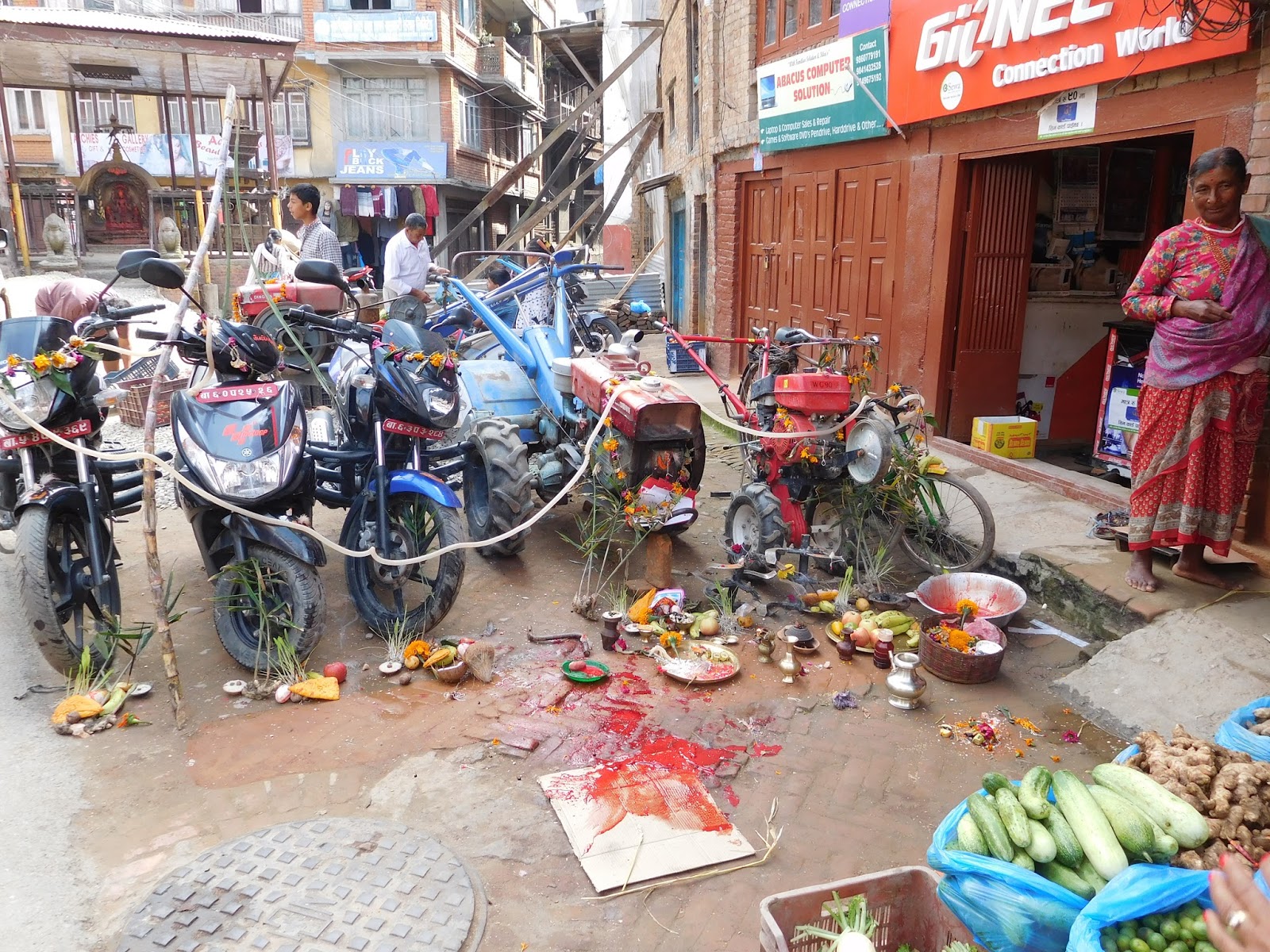
Throughout Nepal cities have emptied, buses and vehicles have been crammed with people and the great Dasain exodus to the villages has begun. The hindu equivalent of Christmas lasts 10 days ( das  meaning 10 in Nepali) and everyone returns to their family home to celebrate. New clothes are bought, presents are exchanged and barley grains are germinated at the start of the festival to be used for puja ( worship) on the final two days. For those who cannot get to a temple to worship, there are tents in the streets of the cities with large statues of the gods and priests to give tikka (blob of red powder between the eyes)to those devotees who donate money. The most visible sign of dasain on the outskirts of Kathmandu are the herds of goat and water buffalo which are brought in for sacrifice to idols and then to provide meat for the feasting. They are dispatched with huge kukries( nepali curved blades) and the meat is then divided up. Despite the festivities there is a dark side to this festival. Many churches also put on programmes at this time since it is a national holiday.
Only the hindus worship idols with sacrifices, take tikka and puja their homes and vehicles with the remnants of the sacrifices in order to get blessings from their gods for journeys in the coming year ( see photos)
Roger and I chose to stay in the city for Dasain and have enjoyed exploring around the valley on our motorbike without  having to negotiate the heavy traffic.
ganesh idol worshipped with flowers, rice and coloured powder

goats waiting to be purchased for dasain

tableaux of gods and goddesses to be worshipped in the city streets

weighing a goat before purchase

vehicles being pujad  with goat remains , flowers and rice

Buying chickens for the feast
Dividing up buffalo meat after a sacrifice

young couple in their dasain best

festivities in street with dasain bamboo swing in the background