Last week I was hobbling on my crutches back to the flat and I saw a small dog running straight towards me dragging a long chain. I got talking to a lady who owned the runaway and she invited me in to her garden for chya ( nepali sweet, spiced tea) and cell roti ( circular bread made by piping the dough into boiling hot oil).
She was the wife of a gurkha soldier and we swapped news about our respective families. I had never met her before but this is typical of the hospitality of the nepali people. As I left she even cut a large mewa (papaya) from her tree as a parting gift. Here is a photo of her with her much loved runaway.
This week the traffic between our flat and the office has often been at a standstill. This is because of the big festival of the rato machendranath (red chariot) which is built every year in the Patan area of Kathmandu where we live. This bizarre structure has a wooden frame bound with jungle vines and houses the golden idol which usually resides in the main temple. During the festival the chariot is pulled through the streets by teams of men. It is so tall that the power lines have to be turned off for the festival and if it topples over dire things are predicted to happen. If it successfully completes its route it is believed that much needed rain will come. In the picture you can see the man dressed in white atop the enormous structure putting the finishing touches to the pennants on the top.
Wednesday, May 11, 2016
Good News!
Today I have several pieces of good news to report. This will help me to forget the enormous black spider which emerged slowly from behind the bathroom cistern to terrify me in the middle of the night. Fortunately Roger rescued me quickly but the humane spider catcher which I had brought from the UK was completely inadequate since this creature was much too large to fit into the suction tube!
So, back to the good news: firstly we now have plenty of water since our landlady arranged for a tanker to deliver some to refill the well which was running dry. Secondly I have now parted company with my plaster cast after five long weeks and it is wonderful to be able to get around with just a trekking pole instead of crutches. I am doing the physiotherapy exercises and improving every day.
Also, the government has distributed free textbooks to hundreds of schools and although there have been some issues with quality, this should have a positive impact on the progress of many very poor students. The government schools are free but the cost of uniforms, textbooks, exercise books, pens and school bags can be prohibitive for these pupils. Scholarships are available, both from the government and N.G.O's ( non government organisations) but there are never enough to meet all the needs.
In addition, the post earthquake reconstruction of individual houses has now begun in earnest, our project had already trained workers in earthquake resistant building methods using local materials and now that the government permissions have been granted, work is proceeding quickly.
So, back to the good news: firstly we now have plenty of water since our landlady arranged for a tanker to deliver some to refill the well which was running dry. Secondly I have now parted company with my plaster cast after five long weeks and it is wonderful to be able to get around with just a trekking pole instead of crutches. I am doing the physiotherapy exercises and improving every day.
Also, the government has distributed free textbooks to hundreds of schools and although there have been some issues with quality, this should have a positive impact on the progress of many very poor students. The government schools are free but the cost of uniforms, textbooks, exercise books, pens and school bags can be prohibitive for these pupils. Scholarships are available, both from the government and N.G.O's ( non government organisations) but there are never enough to meet all the needs.
In addition, the post earthquake reconstruction of individual houses has now begun in earnest, our project had already trained workers in earthquake resistant building methods using local materials and now that the government permissions have been granted, work is proceeding quickly.
Tuesday, April 26, 2016
Kaskikot village stay
After staying overnight in Dharding, we drove on to Pokhara,
where we used to live, It is now a very big dirty city and the mountains were
obscured by cloud but we stayed in a
friendly guest house at the lakeside for a couple of nights which gave us a chance
to have hot showers, wash our clothes and regroup before Roger and I travelled
by taxi up to a hill called Kaskikot for our village stay. This was part of our
orientation programme and the idea is to live with a rural nepali family and
experience their lifestyle. Because of my plaster cast, it was quite a
challenge getting from the taxi down the track to the house which had a stone
yard looking out over the hills and the lake way below. It was the same
altitude as the top of Ben Nevis but here that is just called a hill or Kot!
The house consisted of three bedrooms and a kitchen each
opening onto the courtyard with a large plastic water tank with a tap in it
above a concrete area for washing dishes, brushing teeth and washing people.
The house was a new one made of concrete to replace the old house badly
damaged by the earthquake. The chickens wandered about everywhere and the water
buffalo was penned just below the yard, next to the goats. The family consisted
of Parvati (name changed), the mother, 4 daughters, a son, and granny, all
living at home except for one married daughter.The father worked in Pokhara and
was rarely there. Every morning we were up at 6 by which time the girls were
already carrying water from the village tap to fill their tank. It took 10
water pots each day for the families needs, even though clothes were washed in
the village pokhari( pond) where the buffalo enjoyed wallowing in the heat.
One afternoon it was stiflingly hot and a thunderstorm was
brewing. Roger helped Parvati shield her precious vegetable seedlings from the
rain and we sheltered inside while it hailed onto the tin roof. The next
morning it was beautifully clear and I was keen to see the glorious mountains visible
from the other side of the hill. Roger eventually found a taxi passing through
the village and he took me to see the mountains. A kind nepali gentleman
invited us to the back of his home which faced the mountains so I got to see
them even though I could not make the view point on crutches.
We were sorry to leave the family but eventually it was time
to say goodbye and make our way back to Pokhara where we had our first shower
in days, wonderful!
Field visit to Dharding, close to the epicentre of last years earthquake
It was appropriate that our first field trip was to Dharding
district, close to the epicentre of last April’s earthquake. We left Kathmandu
at 7 am in a project 4x4 vehicle accompanied by our German guest from Bread For
the World, a knowledgeable nepali colleague of Roger’s and our excellent driver. After negotiating
the usual heavy traffic and sheer drops of the road leaving the city, we
stopped to look at some mushroom growing projects. We then travelled off road
down dirt tracks that seemed far too narrow for a vehicle to pass until we
stopped in front of a buffalo shelter by a little farmhouse looking out onto an
idyllic little valley with green irrigated terraces set against the dry, wooded
towering hills. I am still not able to put weight on my foot but a chair was
brought for me and I sat in the shade overlooking the valley, drinking tea,chatting
and eating the fresh cucumbers brought by the farmers who were in the middle of
harvesting them. I also talked to lots of villagers passing by and the
conversation was usually about my plaster cast and how many children I had and
they had and what were were doing up in their village today. I also saw some
beautiful birds, so although we had not been able to set up educational visits
due to the school holidays, I was so glad I had made the effort to go on the
trip.
It was shocking to
see that almost every home had been damaged by the earthquake and repair work
had still not been started, with tarpaulins and corrugated iron sheets plugging
gaps in walls a whole year after the big quake.
My First Earthquake After Shock
I was quietly reading a book in our apartment last week when
suddenly there was a rushing wind through the mosquito screening, the open
windows rattled and then the whole building shook for about 5 seconds if it was
a wet dog shaking off water. For a second I did not realise what was happening,
then all the neighbours’ dogs started barking and our nepali neighbours all
rushed out onto the street. I grabbed my crutches and went to the kitchen where
Roger was still continuing to cook our dinner. “don’t worry, it’s just an after
shock” he said calmly and went downstairs to calm the neighbours before
returning to reassure me that we did not need to do anything else since our
go-bag was ready if another shock arrived. He was quite right, there were no
more tremors and after a while everyone went back outside. Later, I looked it
up on the internet and found it was 4.7 but the epicentre was in our
neighbourhood so it felt worse. Tremors like this are still happening every
couple of weeks in different parts of Nepal but they are decreasing in
intensity and frequency which is reassuring!
Monday, April 11, 2016
A small accident
Just as I was feeling in control and enjoying getting exercise each day by walking 45 minutes each way to the office, I was overtaken, in the words of Harold Mcmillan by " events, dear boy, events"!
I was walking fast along an unsurfaced dusty roadway close to the bridge over the stinking (literally) , Bagmati river when I reached a fork in the road and for a minute was undecided about which route to take. I must have hit a stone while I was off balance and the next thing I knew I was pitched forward. Determined not to hit the ground, I held myself with my twisted left foot and knew I had caused some serious damage. I rang Roger who rescued me with a taxi and I managed a couple of hours at work but realised it needed an x -ray. We went to the nearest good hospital and I was treated by a very competent orthopaedic surgeon who diagnosed a fracture of the 5th metatarsal. After 10 days in a splint I now have a bright green plaster cast and am pretty mobile on my crutches outdoors and in my office chair with wheels around the flat. After another 3 weeks I will be able to put weight on it which will be easier. The German health insurance doctors are on my case too, have seen my scanned x-rays and agree with all the treatment so that is very reassuring.
As you can see , I am trying not to let it curtail my bird watching-we saw a spectacular red billed blue magpie in the botanical gardens at Godaveri at the weekend- it had an amazingly long tail.
I was walking fast along an unsurfaced dusty roadway close to the bridge over the stinking (literally) , Bagmati river when I reached a fork in the road and for a minute was undecided about which route to take. I must have hit a stone while I was off balance and the next thing I knew I was pitched forward. Determined not to hit the ground, I held myself with my twisted left foot and knew I had caused some serious damage. I rang Roger who rescued me with a taxi and I managed a couple of hours at work but realised it needed an x -ray. We went to the nearest good hospital and I was treated by a very competent orthopaedic surgeon who diagnosed a fracture of the 5th metatarsal. After 10 days in a splint I now have a bright green plaster cast and am pretty mobile on my crutches outdoors and in my office chair with wheels around the flat. After another 3 weeks I will be able to put weight on it which will be easier. The German health insurance doctors are on my case too, have seen my scanned x-rays and agree with all the treatment so that is very reassuring.
As you can see , I am trying not to let it curtail my bird watching-we saw a spectacular red billed blue magpie in the botanical gardens at Godaveri at the weekend- it had an amazingly long tail.
Tuesday, March 29, 2016
Happy Easter
Easter is my favourite time of the year and we celebrated the resurrection of Jesus at the international church in Kathmandu, followed by lunch with friends and phone calls to our children.
On Maundy Thursday we hired a taxi after language classes and drove up to Nagarkot, a hill on edge of the valley and had a 2 night break. At 2165 metres the air was clean, the temperature cool and the bird song in the mornings magical. Unfortunately cloud obscured the views of the mountains but we will return after the monsoon to see the views.
We watched the eagles soaring overhead and during our 4 hour walk saw a number of new (to me) bird species, my favourite was the monarch, a bright blue bird about the size of a blackbird with a glorious song. There were a few of the famous rhododendron trees out in flower too.
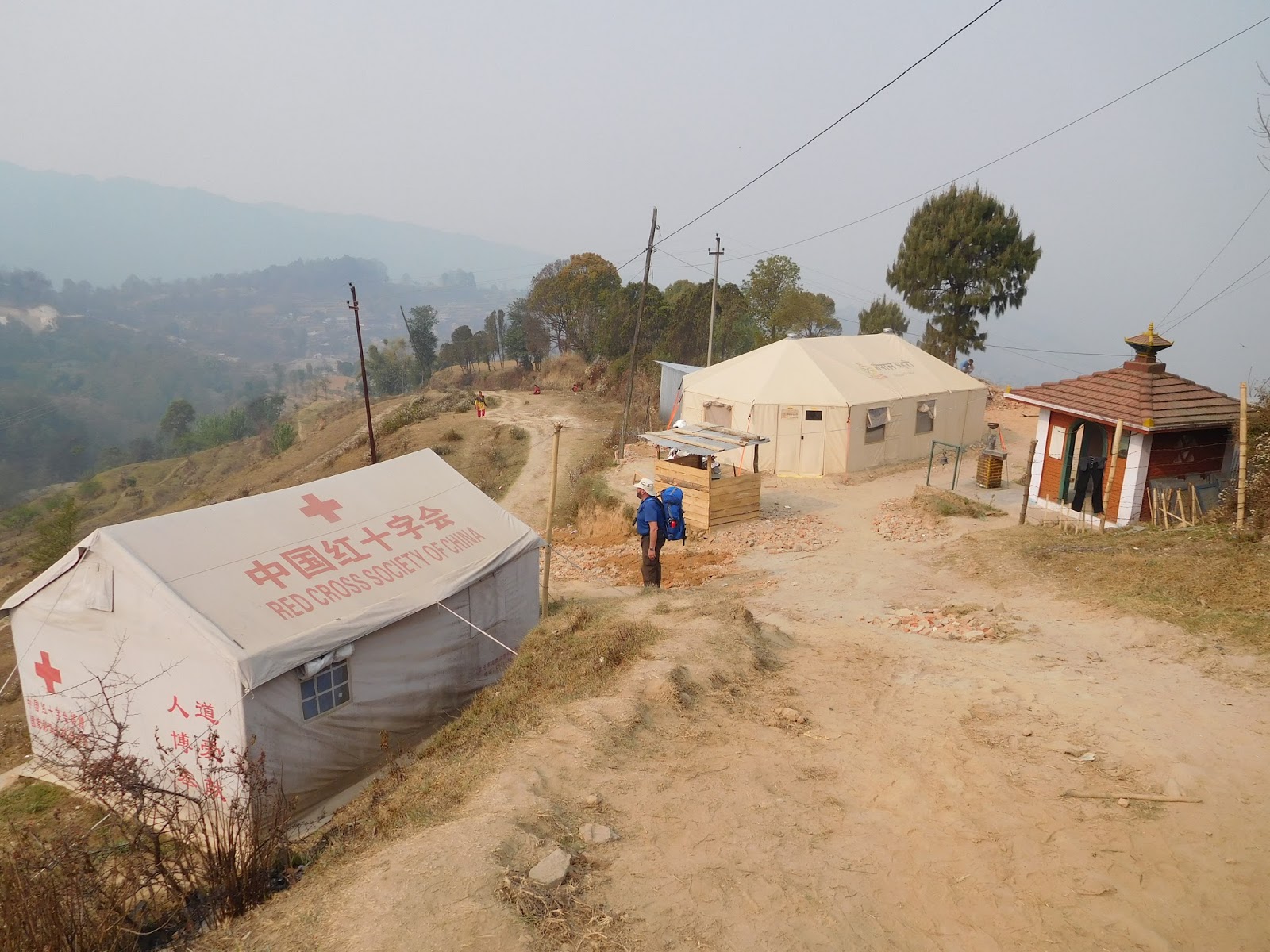
On Saturday we shouldered our rucksacks and walked down through the villages to Telkot. The trail wound past village houses badly damaged by the earthquake a year ago. Some were partly destroyed, with people
le living in one part of the building , but others were so damaged their owners were in tents or corrugated iron temporary shelters. These must be like an oven in summer and freezing in winter, here are some pictures so you can see for yourself:
On Maundy Thursday we hired a taxi after language classes and drove up to Nagarkot, a hill on edge of the valley and had a 2 night break. At 2165 metres the air was clean, the temperature cool and the bird song in the mornings magical. Unfortunately cloud obscured the views of the mountains but we will return after the monsoon to see the views.
We watched the eagles soaring overhead and during our 4 hour walk saw a number of new (to me) bird species, my favourite was the monarch, a bright blue bird about the size of a blackbird with a glorious song. There were a few of the famous rhododendron trees out in flower too.
On Saturday we shouldered our rucksacks and walked down through the villages to Telkot. The trail wound past village houses badly damaged by the earthquake a year ago. Some were partly destroyed, with people
le living in one part of the building , but others were so damaged their owners were in tents or corrugated iron temporary shelters. These must be like an oven in summer and freezing in winter, here are some pictures so you can see for yourself:
Subscribe to:
Posts (Atom)