Thursday, October 13, 2016

Dasain festival

Throughout Nepal cities have emptied, buses and vehicles have been crammed with people and the great Dasain exodus to the villages has begun. The hindu equivalent of Christmas lasts 10 days ( das  meaning 10 in Nepali) and everyone returns to their family home to celebrate. New clothes are bought, presents are exchanged and barley grains are germinated at the start of the festival to be used for puja ( worship) on the final two days. For those who cannot get to a temple to worship, there are tents in the streets of the cities with large statues of the gods and priests to give tikka (blob of red powder between the eyes)to those devotees who donate money. The most visible sign of dasain on the outskirts of Kathmandu are the herds of goat and water buffalo which are brought in for sacrifice to idols and then to provide meat for the feasting. They are dispatched with huge kukries( nepali curved blades) and the meat is then divided up. Despite the festivities there is a dark side to this festival. Many churches also put on programmes at this time since it is a national holiday.
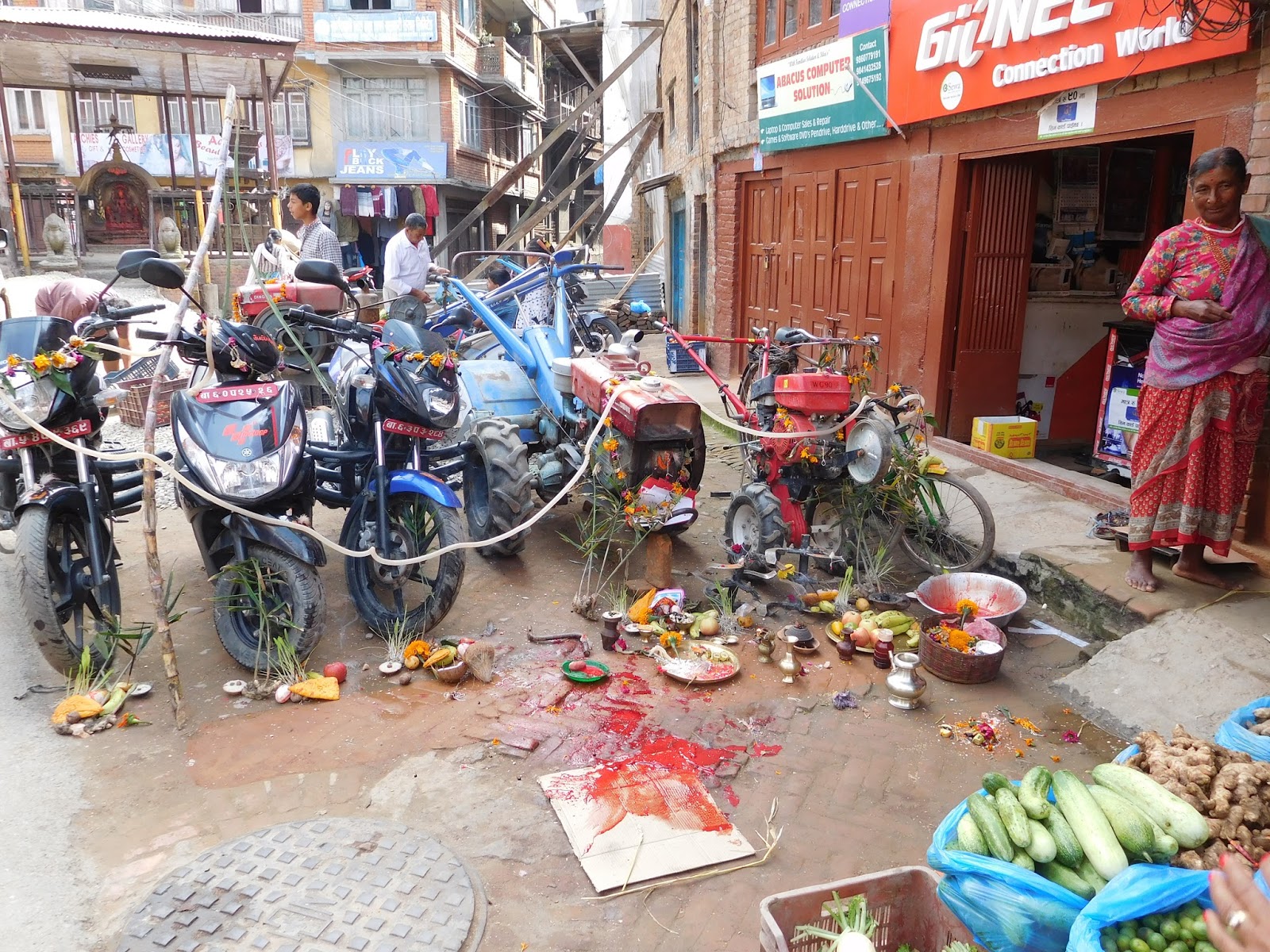
Only the hindus worship idols with sacrifices, take tikka and puja their homes and vehicles with the remnants of the sacrifices in order to get blessings from their gods for journeys in the coming year ( see photos)
Roger and I chose to stay in the city for Dasain and have enjoyed exploring around the valley on our motorbike without  having to negotiate the heavy traffic.
ganesh idol worshipped with flowers, rice and coloured powder

goats waiting to be purchased for dasain

tableaux of gods and goddesses to be worshipped in the city streets

weighing a goat before purchase

vehicles being pujad  with goat remains , flowers and rice

Buying chickens for the feast
Dividing up buffalo meat after a sacrifice

young couple in their dasain best

festivities in street with dasain bamboo swing in the background


Thursday, September 15, 2016

School visit's in Rukum

It was another 8 hour jeep ride to reach the first school we saw and the roads were just dirt tracks around the hillside:
Our route into the hills

A break to take photos

Te kitchen of our inn

In the doorway of our room
The road usually had a sheer drop on one side and there were no road signs or barriers at all.
We stayed in a friendly local inn wher eI got my first ever bed bug bites!
We visited two secondary and one primary school and it ws so good to be talking with students in the classroom again, even if their first language was Magar and so they did not always understand my Nepali. Our INGO, UMN is providing computer labs with 20 computers to 50 several needy rural schools in our working areas. This is in partnership with TAP and Microsoft. I was there to monitor the use of these facilities and to help the local teachers to use more child centred learning techniques. It was good to see how the whole community supported the govenment school and I also met with the school management committees to encourage the whole community to learn to use this resource. Poor children have no choice but ot use the government schools and we are part of a national drive to improve teaching and learning in them.
Talking to the students, it was clear that ,most of them had never even seen a real computer before the lab was installed, they had only seen pictures in books!
Despite the heart rending poverty It was clear that the students were really keen to learn and several of the teachers were teaching  in an interactive way. In the primary school they had addressed the water shortage and the extreme poverty of some of the pupils by providing a wash stand so they could clean themselves on arrival at school.


learning to use excel spreadsheets

Discussing the importance of computers in education

Using multilingual text books in nepali and mugar

wash stand for the primary school children

They also provided porridge at lunch time since  half of the children had to climb up a hillside for at least 30 minutes to get to the school from their village. Overall I was mpressed with the determination of these communities, with a high proportion of illieracy, to improve the education and therefore the life chances of their children.

Wednesday, September 14, 2016

Journey into the western hills

We have just returned from a field trip to Rukum, in the high hills of the mid west of Nepal. Roger and I travelled together but his focus was on climate change issues and mine on education.
We flew out of Kathmandu on a small  plane with only one propeller each side, which always un-nerves me but I did a lot of praying on take-off and landing and all was well. The best bit was that we had picked the side nearest the Himalayas and although it was raining on take-off, the sky cleared and we had some lovely views of the tops of the snow capped peaks with the clouds forming a carpet below them.

view of the Himalayas from the plane


Once we arrived in Nepalgung, a town right on the border with India in the flat terai region in the south,  we were met by a member of our field staff and shown to our Jeep.   We travelled for eight hours along roads that snaked around the hills with sheer drops on one side for most of the way. We forded small rivers and passed too many cleared landslides to count. The most alarming one was so recent that a digger was still clearing it and our driver drove as fast as he could since a tree was leaning at an alarming angle right above the road.
waiting for a landslide to be cleared
 We stopped for delicious dahl bhat with local meat and vegetables and then pressed on until we reached a big river. Here we left our jeep to walk over a swing bridge and up a hill to meet our second jeep. We were bringing multilingual educational text books  written in nepali and also in the local language, Mugar, to our partner schools in Rukum, Therefore these had to be carried by porters up by porters together with our own small cases. In the dry season the jeeps can ford this particular river but it was too high for our vehicle to cross.
The day we travelle dwas Teej, the annual womens festival when women and girls put n their best clothes, do their hair and the married women return to their mothers house. It was lovely to see them dancing in the villages as we passed.
Women gathered to dance and celebrate Teej

In one village we also saw this particularly well constructed festive swing.
Some of the men also enjoyed the Teej holiday

 Eventually we reached Rukum and gratefully settled into our guest house. The food was all cooked over a wood stove and the accommodation was clean but the best bit was the stunning views out over the hills and down the valley to the river.
arrival at Rukum

Sunday, August 21, 2016

Pokhara networking visit

Last week, Roger and I travelled 7 hours by bus from Kathmandu to Pokhara ( where we lived when the children were small).This was a work trip and we had separate programmes arranged which took 5 days. The monsoon is still causing heavy rain and thunderstorms and in Pokhara the rain was torrential, but usually in the evenings so we got some good views of the Himalayas early in the morning.


I visited Amer Singh school, the only government one in the country with a specialist unit for blind and partially sighted students . The students come long distances and board in the hostel from the ages of about 6 until their secondary education is complete. Those from remote regions only return home once a year in the long vacation. On arrival they are taught braille and mobility and once they mastered these they enter the main school at whichever grade is appropriate for their ability. The students have 1:1 support in class, help from a teacher after school for homework and read both English and Nepali braille. Exams are sat with the help of a reader. Computer provision requires improvement and I hope to be able to mobilise some support for
this in the future.
A 14 year old student demonstrating his Braille reading skills
Gandaki boarding school was founded by UMN in collaboration with the King and the Nepali Government 50 years ago. The aim was to provide a western style education to students who would then work in the burgeoning tourist industry around Pokhara. From modest beginnings as  a small boys boarding school, it is now the top performing school in Nepal, Ten years ago, in line with its government agreements, UMN handed it over to a Nepali management board and it is now a not for profit organisation. It has a dedicated scholarship department providing school fees and all clothes, food, accomodation and equipment to 25 exceptionally able boys and girls each year from extremely poor backgounds. I had the privilege of talking to some of the scholarship A level students and there stories, achievements and aspirations were inspirational.

 The Principal, Mr Baral, honoured me by asking me to speak to assembly when all 1400 of his students assembled outside in the bright sunlight . After discussions with the Principal I spoke briefly at a staff meeting on teaching and learning issues and have been invited back to run a staff training day in November. As well as a tour of the school I was delighted to have the chance to talk with the A level students about preparing their university applications. It was an altogether lovely day!
Speaking at assembly
On another day It was fascinating to talk with Plan-International staff in Pokhara about their extensive and pioneering new education project designed, like UMN's ediucation work, to improve the standards of teaching and learning in government schools. Working closely with the District education Officers, they hope to make improvements in early years literacy that can then be replicated nationally. Particularly interesting were their strategies to engage illiterate parents in helping their children learn to read and write.  The children from very poor families are usually expected to come home from school and just continue with their household or agricultural work. On a positive note, primary school enrollment is now much improved, up to 100% in some areas. Retention and achievement measures are not so encouraging. Because any Nepali families who can afford it, send their children, especially their boys, to private schools, improvements in the government schools help the poorest children in the country.

On a much smaller scale, I visited a small project run by some Nepali friends who help 150 very poor children to access education by providing books, equipment and uniforms for them. They also run a hostel where children from remote regions can stay so they can attend good government secondary schools.I wanted to know the actual cost of educating  a child in the government schools where tuition and  text books are now free. I discovered that many schools  charge enrollment fees, computer use fees, fees for sporting activities, exam fees and even sometimes for "furniture".This is, of course, undermining the Government commitment to provide free education for all students. 
Learning about the actual cost of "free" schooling

Tuesday, August 9, 2016

Monsoon damage

I always carry my camera with me since there is always something bizarre or interesting to see here. Last Wednesday we had a particularly heavy thunderstorm and as I walked home from work the streets were like rivers so I took a taxi back. The next morning Roger and I were walking to the office as usual and to our astonishment, the white temple on the corner just past the Bagmati bridge had collapsed, pulling down power lines, a metal fence and tumbling bricks into the road. A week later and we still have to walk road the masonry and cables and piles of bricks
collapsed temple
 The temple was badly cracked by the earthquakes and it withstood the 2015 monsoon rains but this monsoon it fell down. Apparently UNESCO are concerned about the rate of progress on restoration of the heritage sites here. We walked to Patan durbar square at the weekend and there are now big fences surrounding and protecting the damaged buildings.It is difficult to see how progress can be speeded up when people have only recently been able to start rebuilding the earthquake damaged houses and schools. These must take priority over monuments
an 
New fences protecting Patan Durbar square
On a lighter note, here is a young man painting "no parking" stripes on a new road.He took three days to finish but did a really good job
One nice thing about the monsoon is the speed at which plants are growing now that the rain is here. Many trees have started to flower and we keep noticing interesting new plants like this one.
An extraordinary seed pod , just like a green balloon!

Thursday, July 21, 2016

The digital divide

One of the problems in this country is the huge gap between the very rich, living in luxury and the very poor and marginalised who we are helping. While every wealthy , westernised nepali youth will have a computer and smart phone, and computers available at school, the poor and those living in remote regions have no access at all to computers or the internet. This " digital divide" means that they cannot access the well paid jobs in the cities and abroad which require digital skills. Therefore many thousands of young men travel to the gulf states to work for several years as labourers to support their families back home. Also, students in  schools without computers are denied access to the wealth of free teaching and learning resources now available on line .
The government is committed to providing a computer in every government school and internet connection within 5 years but implementation of this laudable policy presents many challenges.
Several INGO's , including our own project here, are helping with implementation and teacher training. A generous New Zealand donor ( TAP-technology Alleviating Poverty) is providing 20 laptops each together with teacher training and support for many government schools in remote regions and we are involved in the logistics of getting these "computer labs" set up in some of our partner schools. With electricity supplies so erratic here, solar panels provide power to recharge the computer batteries. The whole community is involved in securing and using these computers so that they become a sustainable resource for all ages to use.
The UK is recognised as a world leader in computer education is schools and I was invited this week to be part of an expert panel discussing this issue at a conference for 150 nepali teachers and lecturers. The conference was organised by a well known American computer company who generously sponsors computer training and software access for developing countries like Nepal. In the afternoon we had group work sessions learning about training grants and sponsorships. One fascinating session showcased the next generation of computers, a pair of goggles that enables the wearer to access multiple screens, holograms and virtual displays using their fingertips . It was bizarre to be looking at such an expensive gadget in Kathmandu when so many rural schools do not even have good buildings after the earthquake damage!
My new office
chatting with Nepali teachers at the conference

with the Director from the ministry of Education
 
 
My colleague (on right)about to give  a speech


Demonstration of computer goggles

Thursday, July 7, 2016

Education goals

After a visit to the UK for medical appointments  I am now back in full time work and will start to writing  about what I, my team, and many others working in educational development in Nepal are trying to achieve.
Most parents here value education highly and if they can afford it, they send their children to fee paying schools where there is usually a better standard of teaching and learning than in the government schools which are free up to grade 10 ( age 14/15). Poorer families rely on the free government schools and enrollment has improved since free text books are now provided.
However, poor parents still have to provide money for uniforms, exercise books, stationary, back packs and exam fees which can be a real barrier to sending their children to school. The drop out rates of students in government schools remains high,especially for girls, class sizes are very large and teacher training has only recently been improved. Since children are an important source of labour in poor families, if the education quality is very poor, parents may not feel it is worth the financial sacrifice to keep sending them to school.
UMN and many other organisations provide scholarships to disadvantaged students and a key aspect of my role as education adviser is to help to improve the standard of education in the government schools.Here is a typical unimproved  classroom in a government primary school. The conditions ar every cramped but  notice how all the children go to school in tidy uniforms.

 Even schools with poor infrastructure can improve the learning environment with some fresh paint, posters on the walls and displays of students work. Here are some examples from a  school which is trying to implement a more child friendly approach to learning. Notice the rearrangement of tables instead of having them in rows, allowing the teacher to move around and interact with students . There is also peer teaching and a much more better environment for helping students to learn.